
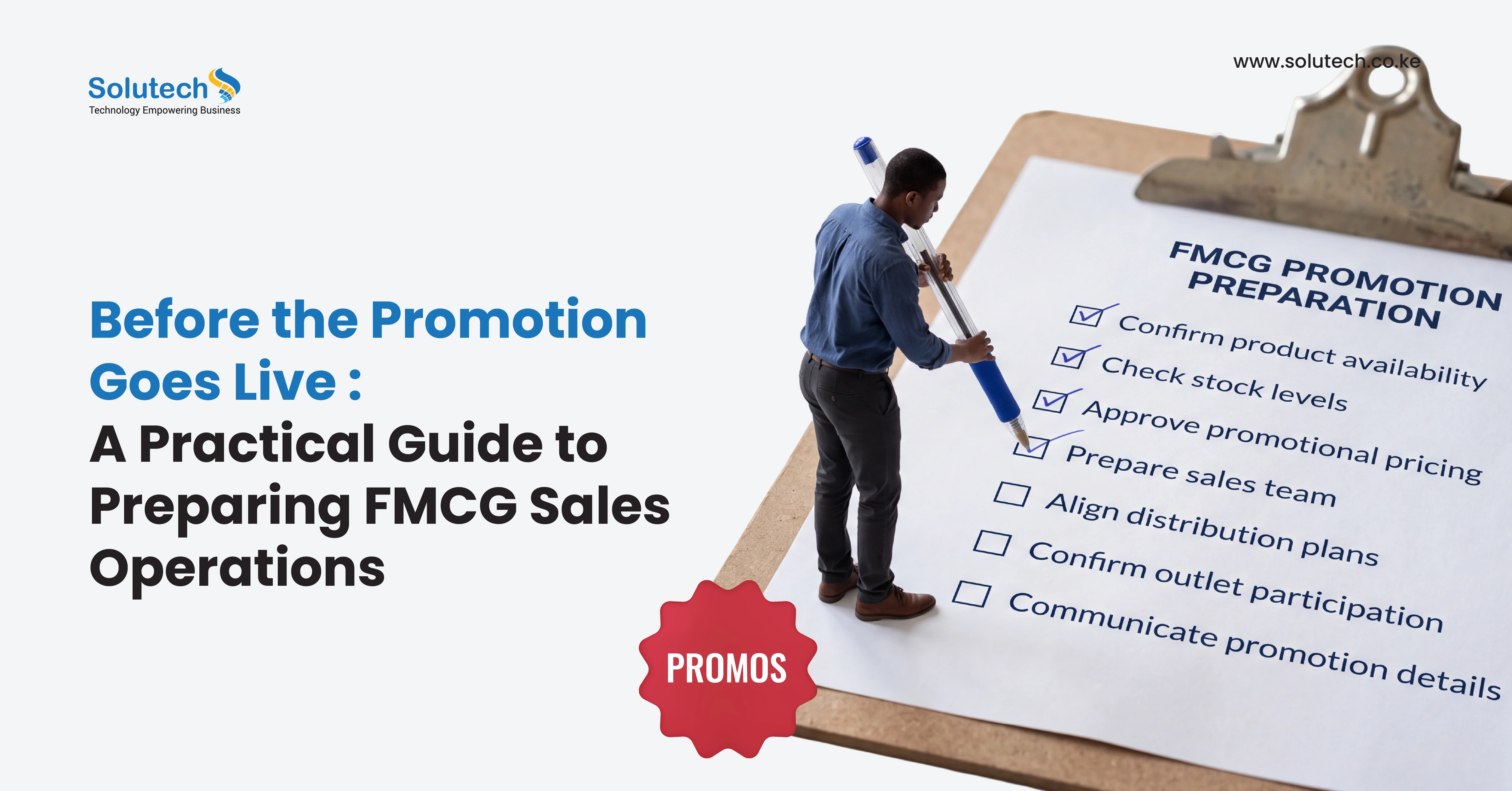
Promotions remain one of the most widely used commercial strategies in the fast-moving consumer goods (FMCG) sector. From price reductions and product bundles to seasonal campaigns and retailer incentives, manufacturers rely on promotions to stimulate demand, accelerate product movement and strengthen market presence.
Yet the effectiveness of a promotion is not determined by the attractiveness of the offer alone. Its success is equally influenced by the commercial infrastructure supporting it: product availability, distribution capacity, salesforce preparedness, retailer participation and the organisation's ability to monitor execution.
This distinction is particularly important for FMCG businesses operating across multiple territories, distributors and retail channels. A campaign may be well conceived, properly funded and effectively communicated, but its commercial outcomes ultimately depend on how consistently it is delivered across the market.
Consider a manufacturer introducing a nationwide promotional campaign. Marketing has established the campaign objectives, distributors have received communication and sales targets have been shared with field teams. However, stock allocation varies across territories, some retailers are unclear about the promotional conditions, and sales representatives are working without a consistent understanding of outlet priorities.
The campaign has generated market interest, but the distribution network is struggling to translate that interest into product availability and sales.
This illustrates an important consideration in FMCG: promotional performance is as much an operational outcome as it is a marketing outcome.
Promotional readiness, therefore, requires businesses to examine whether their commercial operations can accommodate the demand they intend to generate.
1. Product Availability: The Relationship Between Demand and Distribution Capacity
Generating consumer demand is only one part of the promotional equation. The ability to fulfil that demand determines whether the opportunity translates into actual sales.
For manufacturers, this introduces a critical relationship between promotional planning, inventory management and distribution capacity. Increased demand can place additional pressure on warehouses, distributors and retail replenishment cycles. Without adequate preparation, businesses risk creating demand for products that consumers cannot readily find.
Importantly, inventory availability at the central warehouse does not necessarily indicate product availability in the market. Stock may exist within the distribution network while remaining inaccessible to priority outlets or concentrated in territories with lower demand potential.
This distinction makes inventory visibility across the distribution chain particularly important.
Effective promotional planning requires businesses to consider anticipated demand alongside existing stock levels, distributor capacity, product allocation and replenishment timelines. It also requires an understanding of where products are positioned within the distribution network and whether they can reach the intended retail outlets within the campaign period.
The objective is not simply to have sufficient stock. It is to ensure that the right products are available in the right locations when promotional demand materialises.
2. Distributor and Retailer Alignment: Connecting the Commercial Network
FMCG promotions rarely operate through a single business function. Their execution involves manufacturers, distributors, sales representatives and retailers, each with distinct responsibilities in delivering the campaign.
This interconnected structure creates a coordination challenge. Promotional objectives established at manufacturer level must be translated into distribution plans, sales activities and retail participation.
When information is inconsistent across these stakeholders, execution gaps emerge.
For instance, distributors may understand the promotional offer but lack sufficient fulfilment capacity. Retailers may receive promotional stock without fully understanding the applicable pricing conditions. Sales representatives may communicate different offer details across outlets.
Individually, these issues may appear manageable. Across multiple territories and distribution partners, however, they can create inconsistencies that affect campaign coverage, product availability and the customer experience.
The effectiveness of a promotional strategy therefore depends partly on the quality of coordination across the distribution network.
Businesses need a shared understanding of the campaign's commercial objectives, participating products, promotional mechanics, pricing arrangements and fulfilment expectations. Equally important is establishing how orders, stock requirements and execution challenges will be communicated between stakeholders.
This moves promotional coordination beyond simply circulating campaign information. It creates a common operational understanding of what needs to happen, where it needs to happen and who is responsible for delivering it.
3. Salesforce Preparedness: Translating Promotional Strategy into Market Activity
Sales representatives occupy an important position in promotional execution. They connect manufacturers and distributors with retailers, communicate promotional offers, facilitate orders and provide valuable feedback about market conditions.
Their preparedness directly influences how promotional strategies are implemented at outlet level.
However, salesforce readiness involves more than communicating campaign targets. Representatives need to understand the commercial reasoning behind the promotion, the products involved, the intended customer segments and the expected market outcomes.
They also need sufficient information to make decisions during customer engagements.
Which outlets offer the greatest opportunity? Which retailers are eligible for the promotion? Are there specific products that require additional attention? How should representatives respond when customers raise questions about promotional conditions or product availability?
These considerations influence how effectively field teams allocate their time and resources.
For businesses managing geographically dispersed salesforces, consistency becomes particularly important. Representatives working in different territories need a shared understanding of campaign expectations while retaining the flexibility to respond to variations in outlet potential, customer demand and local market conditions.
A prepared salesforce does more than communicate an offer. It provides the connection between commercial strategy and the realities of the retail market.
4. Measuring Execution: Looking Beyond Promotional Sales Targets
Sales growth is an important measure of promotional performance, but it does not always explain how effectively a campaign has been implemented.
A business may achieve strong sales in certain territories while experiencing poor outlet coverage elsewhere. Increased order volumes may indicate demand, but they do not necessarily confirm that products have reached participating retailers or that promotional conditions have been implemented consistently.
This is why evaluating promotional performance requires a broader set of operational indicators.
Outlet coverage, product availability, distributor fulfilment, representative activity, order volumes and retailer participation provide additional context for understanding campaign execution.
These indicators help management distinguish between demand-related outcomes and operational challenges.
For example, declining sales in a particular territory may be associated with limited product availability rather than weak market demand. Similarly, low promotional participation may indicate gaps in retailer communication, salesforce coverage or distributor coordination.
Without this additional context, management risks interpreting performance based on outcomes without understanding the operational factors influencing them.
Establishing clear performance indicators before a campaign begins gives businesses a more reliable basis for evaluating implementation, identifying gaps and making adjustments while the promotion is still active.
5. Operational Visibility: The Importance of Timely Market Intelligence
As FMCG businesses expand their distribution networks, managing promotional execution across multiple territories becomes increasingly complex.
Information is generated at several levels of the commercial operation, from warehouse inventory and distributor orders to representative activities and retail execution. The challenge is ensuring that this information provides a coherent picture of what is happening across the market.
Where reporting relies heavily on disconnected spreadsheets, manual updates and delayed communication, management may struggle to identify execution challenges in time to respond.
This creates an important distinction between having operational data and having operational visibility.
Data may indicate how many orders were recorded or how many outlets were visited. Operational visibility helps management understand where activities are taking place, whether they are aligned with campaign priorities and what those activities reveal about overall performance.
For FMCG leaders, timely access to this information supports more informed decisions throughout the promotional cycle. It enables management to identify underperforming territories, assess field execution, monitor product availability and investigate distribution gaps before they undermine campaign outcomes.
Sales force automation and operational intelligence systems increasingly support this requirement by connecting field activities, sales information and management oversight.
The broader value lies in creating a more informed commercial operation, where decisions are guided not only by reported results but also by a clearer understanding of the activities and conditions shaping those results.
Promotional Readiness Is a Commercial Capability
The success of an FMCG promotion cannot be separated from the operational environment in which it is executed.
Demand generation, inventory availability, distributor coordination, salesforce preparedness and performance monitoring are interconnected elements of the same commercial process. Weakness in one area can affect the effectiveness of the others.
For manufacturers and distributors, this makes promotional readiness an important consideration in commercial planning. It requires businesses to assess not only whether a campaign is attractive to the market, but also whether their distribution networks, field teams and operational processes are prepared to deliver its objectives.
As competition intensifies and distribution networks become more complex, the ability to coordinate execution and maintain visibility across the market becomes increasingly important.
Ultimately, a successful promotion is not simply one that generates demand. It is one in which the business can consistently translate that demand into product availability, retail participation and measurable commercial performance.
See how leading FMCG teams gain real-time visibility from warehouse to shelf.
Explore how Solutech SAT and EVA AI help commercial leaders spot execution gaps early and keep promotions on track.
Solutech. Intelligence on the Go.


