
Payroll is one of the most consistent business processes in an organisation. Every month, it brings together employee information, compensation, statutory deductions and financial records to ensure people are paid accurately and on time.
In Kenya, the payroll function also sits within an increasingly important compliance environment. Employers must account for statutory requirements such as PAYE, NSSF, SHIF and the Affordable Housing Levy, while keeping employee information accurate and ensuring the necessary reporting and remittances are completed.
As organisations grow, however, payroll begins to reveal something beyond the monthly amount to be paid. It provides a regular view of the organisation's workforce and how that workforce is changing.
That raises an important business question: what more can organisations learn from the information already generated through payroll?
Payroll as a source of workforce information
A payroll run contains a considerable amount of information about an organisation. It reflects changes in headcount, compensation, allowances, overtime, benefits and statutory costs. Over time, these records can provide a clearer picture of how workforce costs are developing and where those costs are concentrated.
For a growing business, this information can be particularly useful.
An increase in payroll expenditure, for example, could reflect business expansion and new hires. It could also be influenced by changes in compensation, overtime, allowances or statutory contributions. Looking only at the final payroll figure does not necessarily explain what is driving the change.
This is where payroll data begins to have wider business value.
When payroll information can be viewed alongside other workforce information, HR and Finance leaders have a stronger basis for understanding the factors behind workforce costs and changes in the organisation.
The conversation therefore moves beyond simply completing the payroll cycle. It becomes about making the information generated through that cycle useful for broader workforce management.
Connecting payroll with the wider workforce
Payroll does not exist separately from the rest of the employee lifecycle.
Attendance affects working time. Leave affects workforce availability. Employee movements affect payroll records. Compensation decisions influence workforce costs. Compliance requirements influence how payroll is calculated and reported.
Each of these processes generates information about the workforce.
When that information remains connected, it becomes easier to understand the relationship between people, costs and operations. A change in overtime, for example, may be easier to understand when viewed alongside attendance patterns and workforce deployment. Changes in headcount can be considered alongside departmental costs and business growth.
This connected view is increasingly relevant to organisations that are managing larger teams, multiple departments or operations across different locations.
It also changes the role that payroll information can play in management discussions. Instead of being relevant only when salaries are processed, workforce information can contribute to conversations around planning, budgeting, staffing and organisational performance.
Compliance remains at the centre
Greater use of workforce information does not change the fundamental responsibility of payroll.
Accuracy, timeliness and compliance remain essential.
In Kenya, this is particularly important as businesses continue to navigate changes in statutory requirements and maintain accurate payroll records across their workforce. For organisations operating in more than one African market, the considerations can become more complex as each country may have its own payroll structures, statutory obligations and reporting requirements.
This makes the quality and organisation of workforce data increasingly important.
A payroll system needs to support the requirements of the market in which a business operates while giving the organisation confidence that its employee and payroll information is accurate, accessible and properly managed.
For growing businesses, this becomes part of a broader technology consideration: how can HR and payroll systems support both compliance and better workforce management as the organisation develops?
Where workforce intelligence comes in
The growing availability of workforce data creates another opportunity.
Instead of viewing information generated by HR and payroll systems only as records of past activity, organisations can use it to identify patterns and understand what is happening across their workforce.
This is where workforce intelligence becomes relevant.
Workforce intelligence brings together data from areas such as payroll, attendance, leave, employee records and performance to provide a broader understanding of the workforce. It can help leaders identify changes, examine workforce costs and make more informed decisions.
Artificial intelligence can strengthen this capability by helping organisations analyse information, surface relevant patterns and make large volumes of workforce data easier to interpret.
The value of AI, therefore, is not simply about automating individual HR tasks. Its greater potential lies in helping organisations make better use of the information already being generated across their workforce.
The quality of a workforce decision depends, in part, on the quality of information available to support it.
Why this matters for growing African businesses
The opportunity is particularly relevant as African businesses expand their operations, build larger teams and enter new markets.
Growth brings more employees, more workforce data and, in many cases, more complex payroll and compliance requirements. A business operating across several countries may need to manage different statutory requirements while maintaining a consistent view of its workforce.
At the same time, business leaders need to understand how their workforce investment is developing.
This makes the connection between HR, payroll and workforce management increasingly important.
The objective is not simply to have more data. It is to create a clearer picture of the workforce and make that information useful to the people responsible for managing the organisation.
The next opportunity for payroll
Payroll will always have a fundamental role: ensuring employees are paid accurately, on time and in accordance with the applicable requirements.
But the information generated through payroll has the potential to support much more than that monthly process.
As HR technology becomes more connected, payroll can form part of a broader workforce management environment where employee information, attendance, leave, compliance and compensation can be considered together.
This is the thinking behind KaziTime, Solutech's AI-powered Workforce Management Platform.
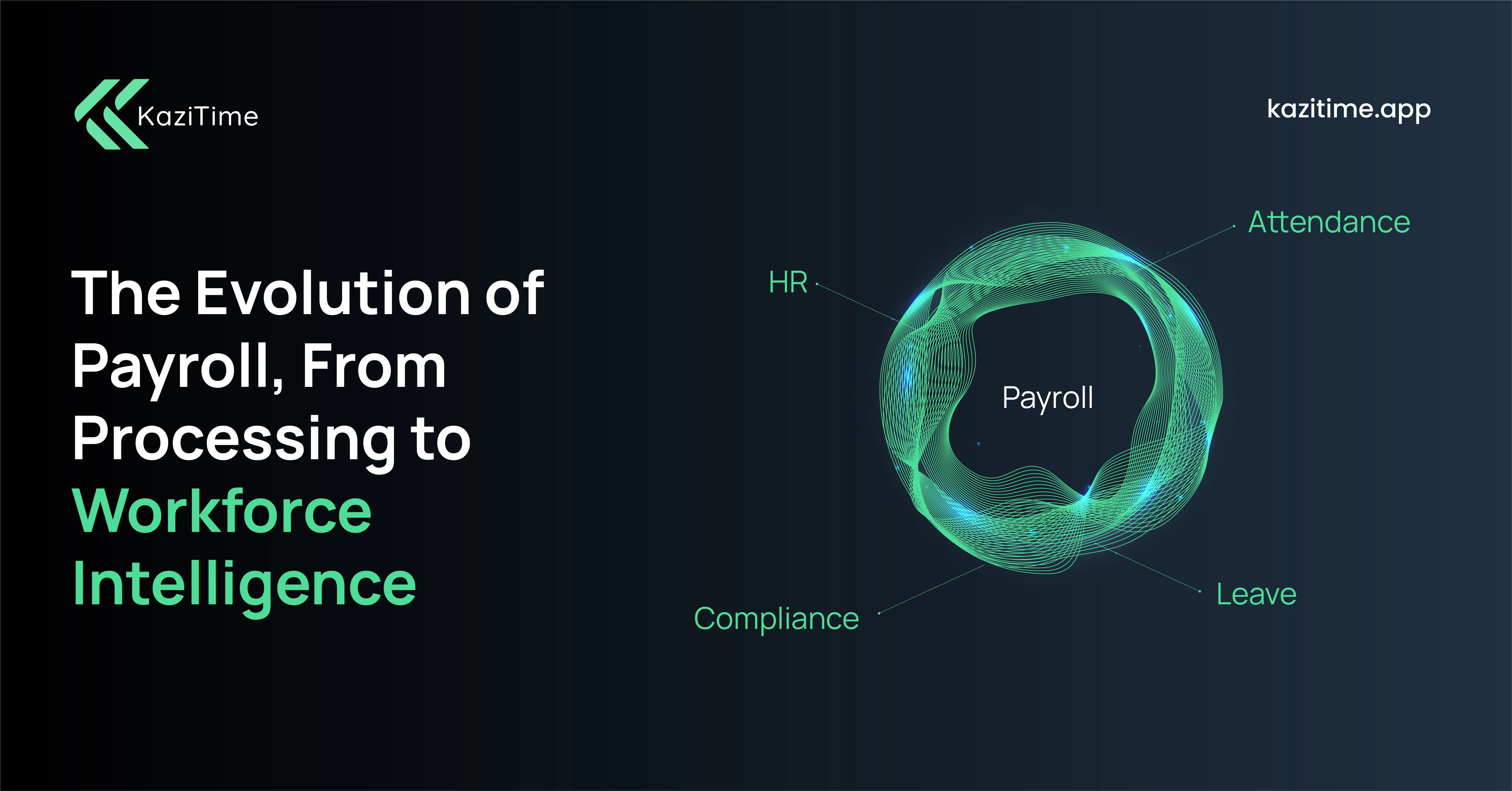
KaziTime brings HR, payroll, attendance, leave and compliance into one connected platform, giving organisations a broader view of their workforce while supporting the day-to-day processes that keep employee management running effectively.
The opportunity is to make workforce information more useful not simply for processing payroll, but for understanding the people and costs behind the business.
Payroll tells an organisation what it needs to pay. Connected workforce intelligence can help it understand why those costs are changing and what they mean for the organisation.
That is where the evolution of payroll becomes particularly significant: not in replacing the fundamentals of payroll, but in expanding the value organisations can derive from the information already within their workforce systems.
Explore KaziTime and discover a more connected approach to HR, payroll and workforce management.


